
INTERNATIONAL ASSOCIATION OF ASTRAL MAGIC
DEDICATED TO ADVANCING PRACTICE AND STUDY
Join us for this IAAM session with Sasha Chaitow as we deep dive into the Byzantine transmission of Solomonic Magic and its cultural influences up through the present moment.
An IAAM Membership gives you access to the association's video library while supporting the IAMM events.
Receive all the benefits of a Membership and become a Benefactor of IAAM to further support our speakers and the mission of the association.
Saturday 19 September 2026, 5:00 pm UTC
10:00 am PDT / 12:00 PM CDT / 1:00 pm EDT / 5:00 pm UTC / 6:00 pm BST / 7:00 pm CEST
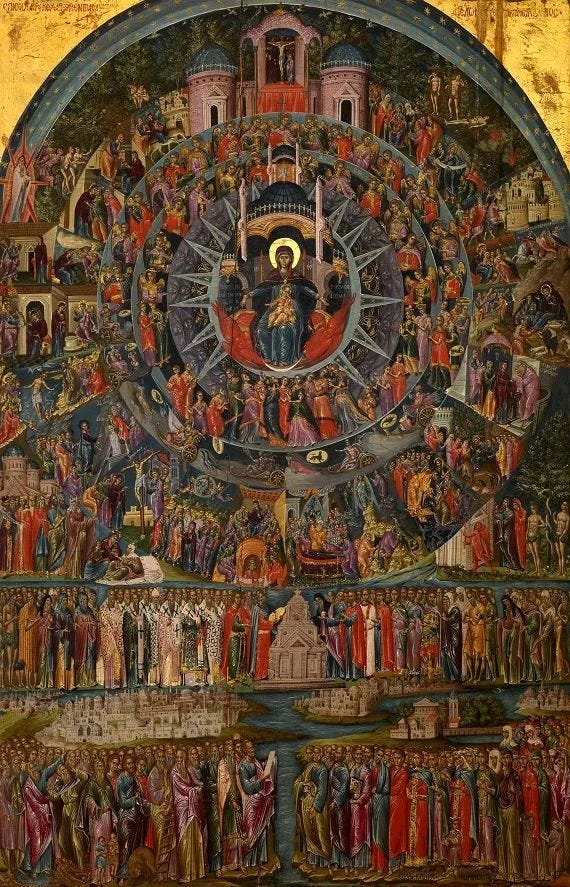
Late 16th century icon by Georgios Klontzas, depicting the Akathist Hymn with Theotokos at the centre. Known as the "Rejoice in you" icon, it is a visualisation of the cosmic hierarchy. Note the signs of the zodiac corresponding to angels in the third concentric circle from the centre. Held at the Hellenic Institute in Venice; many copies exist and adorn churches on Athos, in Greece, other Orthodox countries, and St Catherine's Monastery in Sinai.
In the 11th century, a Byzantine writer made a startling claim: to reject astrology was to deny the wisdom of God. How could a Christian culture employ astrologers at court, teach their knowledge through poetry, use Solomonic manuals and paint the zodiac inside churches?
Across the thousand-year history of Byzantium—the Greek-speaking Eastern Roman Empire centred on Constantinople—astrology and alchemy flourished as bona fide forms of knowledge, while magical and Solomonic practices remained part of religious and practical life. The magical traditions of late antiquity continued through Christianisation, developed within Byzantine culture, and remain present in the Orthodox world today.
This continuity was sustained by Byzantine natural theology. Drawing upon the participatory cosmos of Proklos and its Christian development through Pseudo-Dionysios, the visible world was understood as an ordered expression of divine wisdom. Stars, elements, metals, plants, animals, images, angels, demons and humans were placed within a living cosmic hierarchy, connected through sympathy and correspondence. To study nature was to discover its Creator; the disciplines that revealed its hidden order were understood as branches of divine science, theia epistēmē.
Within this cosmos, astrology revealed the influence of the heavens, alchemy disclosed the powers of matter, and Solomonic practice brought planetary time, sacred names, angels and demons together in ritual action as familiar to the monk as to the midwife.
Through imperial astrology, allegorical poetry, alchemical manuscripts, the Hygromanteia, texts circulating between Greek- and Arabic-speaking worlds, and zodiacal imagery in Orthodox churches, Sasha Chaitow traces the place of these traditions within Byzantine life and their continuation into the present as a lesser-known parallel to Western occultism: a living body of knowledge and practice that was never occulted in the Greek East.
Sasha Chaitow, PhD, is a British-Greek cultural historian, author, artist, and educator whose work bridges scholarship, lived tradition, and visual storytelling.
Trained in the History of Western Esotericism, Literature, Communications, and the Medical Humanities, Sasha brings together rigorous research, insider cultural knowledge, and creative expression.
She is author of a new extensive commentary and translation of Horapollon’s Hieroglyphica; the first full length scholarly study of Joséphin Péladan’s life and work in the French Occult Revival, and is currently contracted for several further titles on Byzantine Demonology; The Evil Eye in the Eastern Mediterranean, and the Greek St. Cyprian. She is also series editor for a major series of medical textbooks. She publishes her ongoing research into Greco-Byzantine magic at thyrathen.substack.com. She is a member of faculty at the University of Patras, Greece, and will be teaching graduate classes in History of Western Esotericism for Cherry Hill Seminary in 2027.